WORKSHEETS
Students will use the chromosome pair models from lesson three to review typical chromosome pairs. Students will then be…
Genes are sets of instructions that help determine certain traits. The environment determines other traits.
ACTIVITIES
Students will be introduced to chromosome pairs and will create their own pair, using the chromosome they constructed in…
Use a lesson that is an introduction to genetics. Students will learn that genes are sets of instructions that determine…
Students will be introduced to two different types of cells: plant cells and animal cells. They will review the…
Students will participate in the "Stroop Test," a well-known scientific activity, that can help them become more aware…
Use a lesson that uses the example of the human eye to explain how our sense organs are connected to the brain. Students…
Students will be introduced to several parts of the eye and their functions. This information will be used in the…
Students will explore how our senses respond to information from the environment. Students will see that our brain plays…
Use a lesson that is intended to help students understand that the brain has many parts and that each part plays a…
Students will be introduced to the atypical brain condition called Lissencephaly. Students will understand that this…
After reviewing the lesson where the students made neuron models and labeled the main parts (dendrites, cell body, axon…
Use a lesson that is designed to help students understand that the brain and the rest of the body are connected, and…
Students will be introduced to neurons: what they are, what they look like, their basic parts, and the "job" (function)…
BOOK GUIDES
Share this literature guide with your secondary students; it provides activities to be used with the bestselling – and…
LESSON PLANS
Explore teaching activities to be used with The Boy Who Saved Baseball by John H. Ritter.
Students will learn/review the three major parts of the human brain, the hemispheres of the brain, where the brain is…
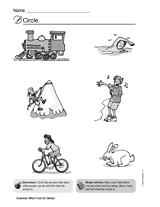
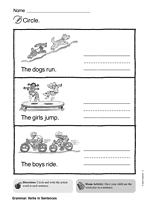
Students circle the pictures that show what people can do and tell what the action is.
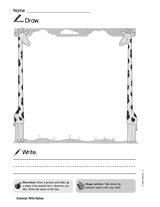
Students draw a picture and make up a name of an animal story character they like and write the name on the line.
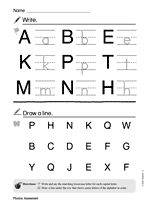
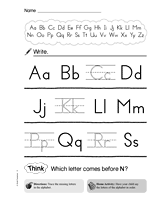
Students write and say the matching lowercase letter for each capital letter, then draw a line under the row that shows…
Students circle and write the action word in each sentence.
Students trace the missing letters in the alphabet.
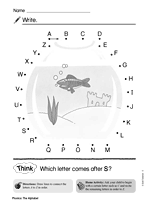
Students draw lines to connect the letters A to Z in order.
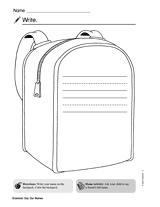
Students write their name on the backpack and color the backpack.