WORKSHEETS
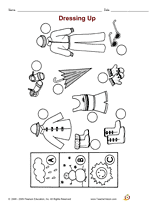
Students chose clothes to show how to dress appropriately for different weather.
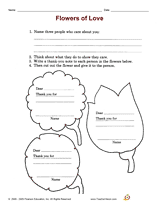
Students write thank you notes to three people who care for them.
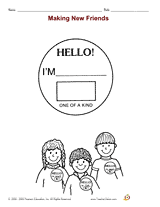
Pupils create name tags to help in meeting classmates.
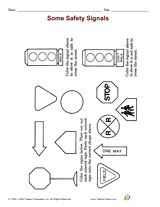
Students learn about common road signs by coloring, cutting, and matching signs.
Students will guide a robot through a maze. They will learn that both humans and robots behave via the operation of…
LESSON PLANS
Students will compare and contrast a human and a robot. This lesson plan from STEPP includes five short activities…
Students will observe developmental changes in newborn mice and an atypical disorder in adult mice.
In this lesson, students will put developing human brains and developing mice brains into order by age, by observing the…
In this lesson, students will review inherited and observable traits, use this knowledge to poll their classmates, and…
Students will be introduced to inherited traits and learn that certain traits are passed on to us from our biological…
Use a lesson that is designed to help students understand that several things can cause atypical vision. Through various…
The rods and cones of your eye are located in the back of your eye, in the retina. The rods allow us to see movement,…
Students will be introduced to several parts of the human eye and their functions. Students will create an eye model to…
Use a lesson that explains that each of our senses is made up of different parts, called receptors. Each receptor plays…
Use a lesson that is designed to help students understand that our brain allows us to function. The lesson centers on…
There are many ways to "create" a model of the human brain. For this activity, students will be using balloons to…
Students will review the three major parts of the human brain and where each part is located.
Students will learn about the human skull and how it protects the brain; however, the skull cannot do this job alone.…
Students will learn that human and other animal brains have many similarities.
Present this lesson plan to introduce students to a few disorders that involve networking within the body. Students will…
These extensions will show students that the brain, not the eyes, is responsible for our ability to see depth. Students…
Present this lesson plan to help students to begin to understand that the networking of circuits in a robot and in a…
Our bodies have many complex, highly interconnected bioelectrical circuits, which allow us to sense and react to changes…
Students will learn fun factoids about neurons, and explore the nature of neurons.