1f2n3n

FREE Lesson Plan - 1st of 3 Free Items

View 2 more resources at no cost, and then subscribe for full access.

Paper Quilts

Grade Levels: 3 - 6

You can't get much more American than a good old- fashioned quilt. With lyrical names like Star of Bethlehem, Log Cabin, and Bee on a Bear's Nose, quilts surely possess the American pioneer spirit. Their patchwork may be presented in squares of symmetrical bouquets or in a happy hodge-podge of appliques, scattered over an aptly named crazy quilt. Whatever format it took, the quilt was, in the end, a kind of cloth history book, incorporating bits and snatches of peoples' lives. It would not be an exaggeration to say that quilts greatly contributed to the very fabric of American folk art! Students will have to be told in advance of this lesson to begin saving and retrieving bits of particular scrap papers.

Objectives

  • Students will make personally meaningful art.

Materials

  • Brown butcher wrap
  • Pencils
  • Yardstick
  • Colored paper
  • Assorted paper scraps
  • Scissors
  • Glue
  • Oil pastels
  • Optional: Research materials from the Internet. See the collection of quilts in the Library of Congress' American Memories. (http://memory.loc.gov/cgi-bin/query/b?ammem/qlt:br001:collection=)

Procedures

  1. Precut butcher wrap to accommodate six to eight students. Each length will represent a "quilt."
  2. The easiest way to establish butcher wrap section sizes is to allocate one quilt per seating, for example, one per desk cluster or worktable.
  3. Cut as needed.
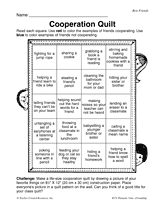
  4. You will find that providing a grid on the butcher paper for the paper quilt "patches" is an efficient approach to this lesson. See figure below.


  5. Measure squares or diamonds in pencil to match the colored paper squares students will be "quilting." Six inches is a good size for squares; leave at least a three-inch border on the butcher wrap between the squares along the outside edge. Precutting construction paper squares also saves time.
  6. Students will have to be told in advance of this lesson to begin saving and retrieving bits of particular scrap papers.
  7. The papers may include gift wrap, greeting cards or postcards, favorite candy wrappers, ticket stubs, and otherwise appealing design paper, such as the wrapper of a special soap. The greater the personal meaning, the better for the quilting bee.
  8. You may contribute with back-up scraps of all kinds.
  9. If you have a real handmade quilt, bring it in.
  10. Show students illustrations of American quilt designs or any examples of actual fabric quilts you might have.
  11. Point out that the saving of fabric from garments long since worn out was the basis for quilts-an early form of what we now call "recycling." How were quilts made? Some combined patchwork and applique. Try to analyze sewing techniques based on your samples and references.
  12. Consider quilt patterns and subjects as well as the meanings some might have to the artisan. Also note the social nature of quilting, which included the opportunity for folks to get together and share experiences and news.
  13. Ask students to show some of the papers they brought in and to tell of their significance.
  14. Distribute precut squares, scissors, glue, and oil pastels.
  15. Cut scrap papers into desired patterns. These may be representational or straightforward designs.
  16. Glue into place.
  17. Do as many "patches" as class time will allow. Just be sure "quilting" looks complete.
  18. Construction paper scraps may be used as "filler."
  19. Oil pastels may be used to indicate "stitches."
  20. Students work their signature or initials onto the patch.
  21. Distribute butcher wrap, oil pastels, and glue.
  22. Glue patches into spaces provided by premeasured grid of brown paper. The area of one's immediate workspace is the fairest way to define "territory." If any squares come up short, students may fill in with extra scrap paper.
  23. Each quilt will have a motif that will be drawn into the borders to unify all diverse patchwork.
  24. The group of students working on their quilt will agree on one common motif, for example, hearts, stripes, snowflakes, stars, daisies, etc.
  25. Each student will be responsible for the borders in his/her work area and will interpret the agreed-upon motif in his or her own way.
  26. Completed quilts should look full and rich, just like the fabric counterpart does. The finished product should make us forget that we are looking at paper.
  27. How many special memories have been "stitched" into these classic quilts?
  28. Preserve the artistry on the wall and display.

Excerpt from Art Smart!


Join TeacherVision
for $39.95 a year and start receiving benefits today!
Free 7-Day Trial

Highlights

November Events

Find educational resources for every day in November. Fill your November lessons with activities for Thanksgiving (Nov. 27).

Math Printables

Browse our most popular math resources in our Printable Rulers & Protractors Slideshow and Number Lines & Place-Value Charts Slideshow.

New Resources

Not only have we added new printable books for Maps & Activities and The Human Body, but we've also focused on new classroom management resources. Try our Homework Excuse Form, Quieting the Class Quickly, Handling Misbehavior During Instruction, and Checking Student Progress in Homework. Take a look at all the new pages added to TeacherVision.

Walden Forums

Wondering about online education at Walden? Get answers to your questions, meet faculty, and learn what it's like to be a Walden student. Click here to check out our free Walden Forums!

2009 Educators' Calendar

There's something worth celebrating every day! Find fun and educationally relevant holidays, events, and celebrations for each day of the year.

Printable Maps

Enrich your lessons with our collection of printable world maps depicting continents, countries, capitals, political boundaries, lines of longitude and latitude, climate zones, oceans, land forms, and more. Plus, browse our collection of Unites States maps.

Daily Printables

Add a TeacherVision widget to your blog, personalized homepage (such as iGoogle or Pageflakes), or social networking sites (such as Facebook). Our widgets feature a different fifth-grade language arts printable or fourth-grade math printable for each day of the year.

Discussion Guide: The Mayflower and the Pilgrims' New World

The teacher's guide for The Mayflower and the Pilgrims' New World, from Penguin Young Readers, is filled with discussion questions, research assignments, and writing activities to engage your students in early American history. Enjoy this book with your students around Thanksgiving or when introducing them to the Colonial Period and Native American History.