
The Grapes of Wrath
by John Steinbeck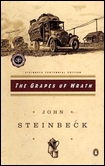
- Introduction
- Preparing to Read
- Understanding the Story
- Writing Responses
- Exploring Further
- Buy this Book!
Enter promo code TEACH for 15% off.

NOTE TO THE TEACHER
The questions, exercises, and assignments on these pages are designed to guide students' reading of the literary work and to provide suggestions for exploring the implications of the story through discussions, research, and writing. Most of the items can be handled individually, but small group and whole class discussions will enhance comprehension. The Response Journal should provide students with a means, first, for recording their ideas, feelings, and concerns, and then for reflecting these thoughts in their writing assignments and class discussions. These sheets may be duplicated, but teachers should select and modify items according to the needs and abilities of their students.
INTRODUCTIONLife during the Great Depression of the 1930s was extremely difficult for almost everyone. But for those who had little to begin with, it created often unbearable circumstances. By 1935, drought and poor farming practices, especially in Oklahoma, Arkansas, Colorado, Kansas, and Texas, led to the wind erosion of topsoil. So severe was this problem that the affected areas of the Great Plains were labeled the Dust Bowl. At nearly the same time, the development of the all-purpose tractor enabled large landowners to dispense with the labor of farmers who were tenants on their land. By the late '30s, a majority of the approximately 1.8 million tenant farmers in the South had been evicted from their homes. Many of the displaced farmers sought work in the "promised land" of California. Eventually, there were as many as 300,000 migrants in California, several workers for every available job in the fertile farming valleys of that state.
In 1936, John Steinbeck conducted research on the people who had moved to California from Arkansas and Oklahoma; in 1937, he toured the Dust Bowl and traveled with migrants on their relentless drive to California. From those experiences he wrote The Grapes of Wrath, which upon publication in 1939 earned Steinbeck both high praise (including the Pulitzer Prize) and harsh criticism for its strong language and sociopolitical implications. The novel continues to be one of the most highly praised and vehemently criticized pieces of American literature.
- In American history texts and other library sources, read about the Dust Bowl and other events of the Great Depression. If possible, obtain some of the famous 1930s photographs of poor farmers, migrant laborers, and people on city food lines. With other students, share what you see in the faces of those people.
- Discuss what happens when machines replace people. What alternatives do unskilled workers have when they are replaced?
- What is your definition of family? Is a family made up only of relatives? What keeps a family together? Of what importance is family unity in today's society?
- Obtain a road map of the United States and, as you read the first half of the novel, trace the route taken by the Joads, noting the location of major events along the way.
- As you read through the novel, stop occasionally to record your thoughts, reactions, and concerns in a Response Journal. Your journal may be a separate notebook or individual sheets which you clip together and keep in a folder. Include statements about the characters - what you learn about them, how they affect you - and your thoughts about the key issues and events which the book explores. Also, jot down questions you have about events and statements in the book which you do not understand. Your Response Journal will come in handy when you discuss the novel in class, write a paper, or explore a related topic that interests you. In addition, because this novel contains several sophisticated words (e.g., petulant) and unusual expressions (e.g., frawny), you may want to keep a list of some of those words and their meanings in your journal.


